
Unlocking a crucial piece of schizophrenia’s molecular puzzle, scientists at Northwell Health’s Feinstein Institutes for Medical Research have found that jumping genes, also known as transposable elements, are linked to a communication breakdown in the blood gene expression networks of people living with schizophrenia. Jumping genes are DNA sequences from ancient viruses and other elements that could once move around the human genome – and in rare cases still can. This discovery could open new paths for understanding, diagnosing and treating this complex mental illness.
This press release features multimedia. View the full release here: https://www.businesswire.com/news/home/20260901583327/en/
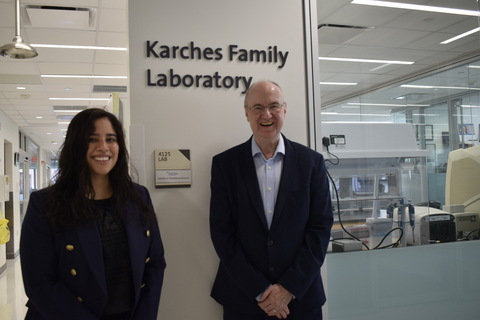
Dr. Helena Reyes-Gopar and Dr. Doug Nixon led the study. (Credit: Feinstein Institutes)
The research, published today in the Journal of Clinical Investigation (JCI), led by Helena Reyes-Gopar, PhD, an investigator at the Feinstein Institutes, and Douglas F. Nixon, MD, PhD, director of the Institute of Translational Research at the Feinstein Institutes, looked at the activity of tens of thousands of genes – including jumping genes – in the blood from patients who were recently diagnosed and had not yet started treatment.
“For a long time, these elements were dismissed as junk DNA. Our study shows they are not only active in blood cells but form integral parts of the gene expression networks that operate in immune cells,” said Dr. Reyes-Gopar, lead author of the paper.
Investigators compared these expression networks in 84 patients relative to 97 healthy individuals. By creating maps of how genes and transposable elements communicate with each other, they discovered significant differences in patients with schizophrenia.
“We found that transposable elements sit at important parts of the expression networks of healthy individuals, but their connections to the other parts of the network are weakened in patients,” said Dr. Nixon. “By mapping these networks in the blood, we are opening new doors. One day this could help us develop therapies that precisely target the disrupted connections we see in schizophrenia.”
The research revealed several crucial insights. In individuals with schizophrenia, the intricate communication network between genes and transposable elements was severely disrupted. In healthy individuals, these elements act as central hubs with extensive connections to other active genes, but in the newly diagnosed patients in this study, these critical links were compromised or lost. This widespread breakdown was accompanied by a silencing effect: Many transposable elements that are normally active became significantly less so in patients. The genes most closely connected to these elements were those involved in immune function, consistent with a role for immune processes in schizophrenia.
This collaborative, global study brought together experts from the Feinstein Institutes, George Washington University and King’s College London.
“Most studies of gene expression in schizophrenia have set transposable elements aside, for technical reasons and because their role was unclear,” said Rodrigo R. R. Duarte, PhD, research fellow in medical and molecular genetics at King’s College London. “We find that these elements are central features in expression networks, which is a strong signal that they should not be ignored. And although schizophrenia is a disorder of the brain, these signatures are clearly detectable in blood, an accessible tissue, which fits with the immune side of the disorder and makes them far easier to study. Accounting for them gives a fuller picture of the molecular biology underlying schizophrenia.”
“Our study showcases the power of advanced computational biology to uncover hidden complexities in disease,” said Matthew L. Bendall, PhD, associate research professor of biostatistics and bioinformatics at George Washington University. “By integrating transposable elements into gene regulatory networks, we were able to map a landscape of disrupted connectivity in schizophrenia that was previously invisible.”
Key to the discovery was Telescope, a tool Dr. Bendall developed while working in Dr. Nixon’s laboratory and the leading method for measuring the activity of individual transposable elements at their precise locations in the genome.
“This study expands our understanding of schizophrenia, revealing a molecular communication breakdown in the blood,” said Kevin J. Tracey, MD, president and CEO of the Feinstein Institutes and Karches Family Distinguished Chair in Medical Research. “This new insight into the disease’s immune component paves the way for molecular diagnostics and novel therapeutic strategies.”
Last year, Dr. Nixon, a recognized pioneer in the study of the “dark genome” and its influence on neurodevelopmental and mental health conditions, was inducted as a Fellow of the Infectious Diseases Society of America.
About the Feinstein Institutes
The Feinstein Institutes for Medical Research is the home of the research institutes of Northwell Health, the largest health care provider and private employer in New York State. Encompassing 50+ research labs, 3,000 clinical research studies and 5,000 researchers and staff, the Feinstein Institutes raises the standard of medical innovation through its six institutes of behavioral science, bioelectronic medicine, cancer, health system science, molecular medicine, and translational research. We are the global scientific leader in bioelectronic medicine – an innovative field of science that has the potential to revolutionize medicine. The Feinstein Institutes publishes two open-access, international peer-reviewed journals Molecular Medicine and Bioelectronic Medicine. Through the Elmezzi Graduate School of Molecular Medicine, we offer an accelerated PhD program. For more information about how we produce knowledge to cure disease, visit http://feinstein.northwell.edu and follow us on LinkedIn.
View source version on businesswire.com: https://www.businesswire.com/news/home/20260901583327/en/
Media gallery


