SHANNON, CLARE, IRELAND, July 24, 2026 /EINPresswire.com/ —
Announcing a new publication from Opto-Electronic Advances; DOI 10.29026/oea.2026.250306.
Modern imaging is increasingly expected to do more than “take a picture.” In many real-world scenarios, what matters is not only the overall brightness of an object, but also where its boundaries, interfaces, and fine structural transitions are located. Edge information is crucial for tasks such as identifying cell membranes in transparent biological samples, tracking subtle morphological changes over time, or extracting structural cues for machine vision. Traditionally, however, obtaining both conventional bright-field images and edge-enhanced images requires either multiple optical elements, sequential measurements, or computational post-processing. These requirements increase system size and complexity, and they often slow down data acquisition, which is particularly limiting when the target is dynamic.
Metasurfaces and metalenses offer a compelling route toward compact optical systems because they replace bulky lenses with flat, microstructured devices that shape wavefronts directly. Yet most compact meta-imaging systems still face two common obstacles. First, they typically provide a single imaging function at a time, or require switching mechanisms (for example, changing illumination conditions or inserting extra optics) to alternate between modes. Second, they often operate reliably only over a limited field of view, meaning image quality degrades noticeably when the object or illumination becomes off-axis.
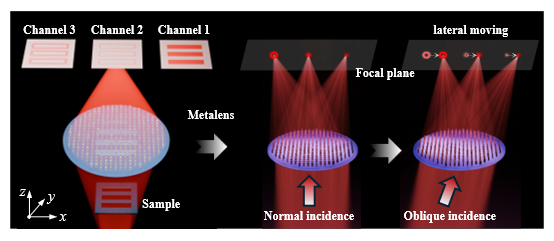
To address these constraints, A collaborative research team spanning Pohang University of Science and Technology (POSTECH), Korea University – Sejong Campus, Harbin Engineering University, and the Shanghai Institute of Optics and Fine Mechanics reports a polarization-encoded trichannel metalens that performs parallel bright-field imaging and multi-order edge detection within a single, compact and static meta-optical platform. The central advance is the integration of three distinct optical operators into three polarization-defined channels: Channel 1 (RCP to LCP) for bright-field imaging, Channel 2 (RCP to RCP and LCP to LCP) for first-order edge detection, and Channel 3 (LCP to RCP) for second-order edge detection.
Functionally, the device combines a spin-independent phase component and a spin-dependent phase component. A spin-dependent gradient phase is employed to spatially separate the channel outputs, enabling all three imaging modalities to be recorded simultaneously within a single CCD imaging area under linearly polarized illumination and detection, without dynamic switching or additional optical components. Experimentally, the metalens shows stable, clearly separated parallel imaging performance over a field of view ranging from -10° to 10°.
Key quantitative device parameters reported include a numerical aperture of 0.503 and a focal length of 430 µm at 635 nm. The measured focusing efficiencies are 41.7% (Channel 1), 25.1% and 28.3% for the two polarization-preserved realizations of Channel 2, and 14.5% (Channel 3). In imaging demonstrations, the metalens is validated on a USAF 1951 resolution target and on representative biological specimens (Spirogyra conjugation and Volvox), where the edge-enhanced channels highlight structural boundaries and textures that are difficult to discern in conventional bright-field images.
Beyond polarization multiplexing via Jones-matrix engineering, the authors also position their approach relative to complementary strategies for parallel meta-imaging, including off-axis phase engineering for spatial separation of functionalities and staggered or supercell-based meta-atom arrangements for complex-amplitude synthesis and multi-order differentiation. Taken together, these directions suggest a broader roadmap toward compact meta-optical platforms with increased channel capacity, enriched imaging operators, and improved power allocation and channel isolation, while the present work emphasizes a system-levelly simple route with straightforward channel addressing through polarization. By integrating multiple imaging operators into one planar element, this approach points toward compact, high-throughput imaging platforms where intensity and edge information can be accessed simultaneously, which is attractive for biomedical imaging, real-time edge analysis, and machine vision applications.
This work is carried out by a joint team from POSTECH (Republic of Korea), Korea University – Sejong Campus (Republic of Korea), Harbin Engineering University (China), and the Shanghai Institute of Optics and Fine Mechanics, Chinese Academy of Sciences (China), together with related research centers at POSTECH and Korea University – Sejong Campus. The corresponding authors are Prof. Junsuk Rho (POSTECH) and Prof. Trevon Badloe (Korea University). Their research focuses on metasurfaces and flat optics, including polarization-multiplexed meta-imaging, multi-functional metalenses, and compact optical systems that integrate imaging and optical analog information processing.
Keywords: trichannel metalens; multi-functional imaging; wide field-of-view; edge detection; bioimaging
# # # # # #
Junsuk Rho is the Mu-Eun-Jae Endowed Chair Professor and a Young Distinguished Professor in the Departments of Mechanical Engineering and Chemical Engineering at Pohang University of Science and Technology (POSTECH), South Korea. He also serves as the Director of the POSCO-POSTECH-RIST Convergence Research Center for Flat Optics and Metaphotonics. He earned a degree in English, French, and Chinese from Myeongdeok Foreign Language High School in Korea, and went on to receive his B.S. from Seoul National University (2007), M.S. from the University of Illinois at Urbana-Champaign (2008), and Ph.D. from the University of California, Berkeley (2013). He has previously worked as a postdoctoral researcher in the Materials Sciences Division at Lawrence Berkeley National Laboratory and as a Ugo Fano Fellow—one of the highest honors supported by the U.S. Department of Energy—at the Center for Nanoscale Materials, Argonne National Laboratory.
Personal website: https://photonics.postech.ac.kr/welcome
Trevon Badloe is currently an assistant professor at Korea University – Sejong Campus, South Korea in the Department of Electronics and Information Engineering. He obtained his Ph.D. in Mechanical Engineering at Pohang University of Science and Technology (POSTECH), South Korea (2023) under the guidance of Prof. Junsuk Rho, and conducted postdoctoral research at the Graduate School of AI, POSTECH, South Korea as a PIURI fellow. Before moving to Korea, Trevon received his MPhys (Master of Physics) degree at the University of Sheffield, in the Department of Physics and Astronomy (2012). His research interests are in nano-optics, metaphotonics, and their convergence with AI for inverse design, optical sensing, imaging, and computational optics.
Personal website: https://metai.korea.ac.kr/
# # # # # #
Opto-Electronic Advances (OEA) is a high-impact, open access, peer reviewed SCI journal with an impact factor of 22.4 (Journal Citation Reports 2024). OEA has been indexed in SCI, EI, DOAJ, Scopus, CA and ICI databases, and expanded its Editorial Board to 41 members from 17 countries.
# # # # # #
More information: http://www.oejournal.org/oea
Editorial Board: http://www.oejournal.org/oea/editorialboard/list
All issues available in the online archive (http://www.oejournal.org/oea/archive).
Submissions to OEA may be made using ScholarOne (https://mc03.manuscriptcentral.com/oea).
ISSN: 2096-4579
CN: 51-1781/TN
Contact Us: oea@ioe.ac.cn
Twitter: @OptoElectronAdv (https://twitter.com/OptoElectronAdv?lang=en)
WeChat: OE_Journal
# # # # # #
Li XT, Kim Y, Jeon Y et al. Parallel bright-field and multi-order edge imaging via wide field-of-view trichannel metalens. Opto-Electron Adv 9, 250306 (2026). DOI: 10.29026/oea.2026.250306
Opto-Electronic Advances Editorial Office
Opto-Electronic Advances
+86 591 2286 1222
email us here
Legal Disclaimer:
EIN Presswire provides this news content “as is” without warranty of any kind. We do not accept any responsibility or liability
for the accuracy, content, images, videos, licenses, completeness, legality, or reliability of the information contained in this
article. If you have any complaints or copyright issues related to this article, kindly contact the author above.

Media gallery