WENZHOU, ZHEJIANG, CHINA, April 15, 2026 /EINPresswire.com/ — Up to 30% of weld porosity defects originate from moisture in low-hydrogen electrodes — a detail often overlooked until weld quality fails. Welding electrode insulation boxes serve as the critical control point between proper storage and field performance. Their value is not in heating alone, but in actively managing the microclimate around electrodes throughout the welding lifecycle.
Core Principles and Market Positioning: From “Passive Preservation” to “Proactive Management”
The welding electrode insulation box is not simply a heating container; its core function is to actively combat environmental humidity and establish and maintain a stable microclimate that meets process requirements. This makes it transcend the function of a traditional toolbox, becoming a key component of the welding materials management system.
Far-infrared radiation has become the dominant heating technology in modern electrode insulation boxes. Unlike conventional resistance or hot-air heating, it directly excites water molecules inside the electrode coating, enabling uniform drying from the inside out. The result: ~20% higher thermal efficiency and more stable temperature control — critical for low-hydrogen and high-alloy welding applications. Keygree combines this technology with K-type thermocouples and intelligent PID control to maintain temperature accuracy within ±1°C to ±5°C, meeting stringent process requirements across carbon steel, alloy steel, and heat-resistant alloys.
Evolution of functional positioning: Market demand has differentiated welding rod insulation equipment into two major functional orientations: centralized processing and on-site maintenance for the “last 100 meters”.
Centralized Processing Center (Drying/Insulation Dual-Purpose Box): Represented by the Keygree ZYH/ZYHC series. These devices have large capacities (20-1000 kg), a wide temperature control range (room temperature to 500℃), and integrate drying, insulation, and storage functions. Their initial design purpose is to serve as a “central kitchen” for welding materials in the workshop, providing unified processing for large batches of welding materials to ensure that all welding rods sent to the field are in standard condition.
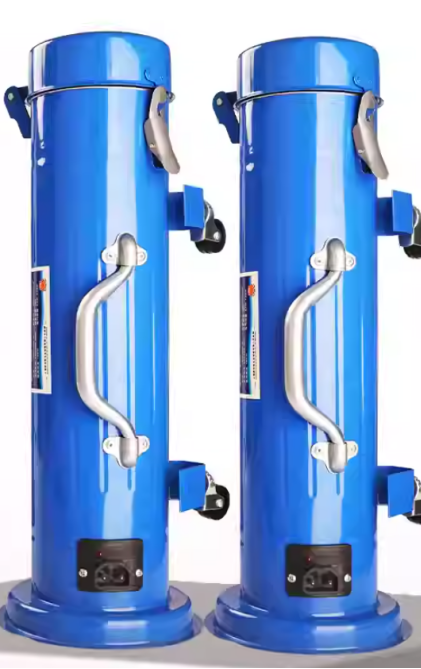
Field Maintenance Terminal (Portable Insulation Container): Typical examples include Keygree’s TRB series and other portable products. These devices have small capacities (typically 5-10 kg), are portable and lightweight, and offer flexible power supply (220V or power from the welding machine). Their core mission is to provide continuous and stable insulation for the small number of welding rods currently in use by welders in the complex and harsh environment of the construction site, preventing dried welding rods from reabsorbing moisture during usage intervals.
In-depth comparison of product forms
Large drying/insulating ovens (such as the Keygree ZYHC series) Portable welding rod heat exchanger Innovative thermal insulation equipment (such as horizontal boxes with spring-loaded strip mechanisms).
Core strengths Strong processing capacity, complete process, and high degree of automation, making it suitable for standardized large-volume operations. Extremely flexible and easy to move, suitable for mobile, high-altitude, and field operations. Convenient to use and does not disrupt the internal environment, effectively reducing heat loss and humidity intrusion, and improving process stability.
Main weaknesses high initial investment, occupies a large area, relies on a fixed power supply (380V), and cannot be moved to the front line for use. Limited capacity requires frequent returns to the central storage for refills, demanding high user discipline in closing the lid. The structure is relatively complex, and the cost may be higher than ordinary insulation cylinders;
Typical capacity/power Capacity: 20-1000kg; Power: 2.0kW – 12kW-10. Capacity: Typically 5-10kg; Power: 0.5kW – 1.5kW. Capacity: Customized, typically 10-50kg; power depends on the design
Optimal application scenarios Fixed workshops such as large shipbuilding, pressure vessel factories, heavy steel structure workshops, and chemical equipment manufacturing. Suitable for outdoor or high-altitude operations requiring frequent relocation, such as construction sites, pipeline installation, equipment maintenance, and bridge construction. Suitable for welding nuclear-grade components, precision instruments, or automated welding workstations where extremely high welding quality is required
What the table reveals is not just product variety, but a system-level logic: Keygree’s portfolio bridges the gap between centralized quality control and distributed field execution. Meanwhile, emerging design innovations — such as low-center-of-gravity horizontal boxes and spring-loaded single-rod dispensers — directly address long-standing field pain points (tip-over risk, temperature instability from frequent lid opening). These represent clear opportunities for Keygree to extend its competitive moat beyond equipment into process reliability.
Economic analysis of application scenarios: a trade-off between cost, risk, and compliance
The decision to apply welding electrode insulation boxes is essentially an economic calculation based on different scenarios.
High-intensity, high-compliance industrial scenarios (such as shipbuilding, nuclear power, and pressure vessels): Here, welding quality is directly related to structural safety and substantial assets. Relevant technical regulations (such as JGJ81-2002) mandate the drying and insulation of low-hydrogen welding electrodes. The rework costs, project delays, and even safety accidents caused by weld defects far exceed the cost of investing in high-end insulation equipment. Therefore, Keygree’s large ZYHC series drying and insulation boxes are a rigid requirement for such customers. Their value lies not only in the equipment itself but also in the process compliance assurance and quality risk mitigation they provide.
For cost-sensitive but quality-critical scenarios — such as general manufacturing and engineering construction — the optimal approach is rarely a single product, but a hybrid deployment model:
A medium-capacity drying box (e.g., Keygree ZYH series) for centralized electrode processing
Portable insulation containers distributed to each welding team for on-site retention
This model balances source control with field flexibility, yielding the highest overall ROI by minimizing both material waste and defect-driven rework — a combination where Keygree is well-positioned to offer bundled solutions.
For scattered work scenarios such as repair and installation: These are characterized by dispersed operations and variable locations. Portable insulated containers are almost the only option. In these situations, equipment reliability, battery life, and tolerance to harsh environments become crucial. Keygree’s portable products, featuring moisture-proof sealing, intelligent temperature control, and overheat protection, can help operators significantly improve the success rate of single operations with minimal equipment investment.
Conclusion
As manufacturing industries push toward higher quality, lower rework, and stricter process traceability, the welding electrode insulation box is shifting from a supporting tool to a process-critical asset. It no longer just stores electrodes — it controls variability. Keygree’s current portfolio already spans the full spectrum from centralized processing to field execution. The next frontier lies in transforming this product breadth into integrated quality management solutions — where intelligence, energy efficiency, and user-centric design become not just features, but the basis for a new category leadership.
Keygree Group Co., Ltd.
Keygree Group Co., Ltd.
+86 18058395375
info@keygree.com
Legal Disclaimer:
EIN Presswire provides this news content “as is” without warranty of any kind. We do not accept any responsibility or liability
for the accuracy, content, images, videos, licenses, completeness, legality, or reliability of the information contained in this
article. If you have any complaints or copyright issues related to this article, kindly contact the author above.

Media gallery