Why Your House Is Shifting: How to Spot Structural Separation Before It Gets Worse
Rochester, United States – March 11, 2026 / Highlander Waterproofing & Foundation Repair /
For most homeowners in Western Pennsylvania, Western New York, and Eastern Ohio, the home is more than just a shelter; it is the most significant financial investment of their lives. We expect the walls to stay upright and the floors to remain level. however, beneath the surface, geological forces are constantly at work. One of the most terrifying realizations a homeowner can have is noticing a physical gap where the house seems to be “unzipping” from its own base.
Foundation wall separation—the process of a wall pulling away from the footer or the rest of the structure—is a high-priority structural emergency. Unlike a small hairline crack caused by simple concrete shrinkage, separation indicates that the very bones of your home are moving in different directions. At Highlander Waterproofing & Foundation Repair, we’ve spent nearly 40 years diagnosing these shifts. Understanding why this happens and how to spot it early can be the difference between a surgical repair and a total foundation failure.
What Causes a House to “Pull Away” from its Foundation?
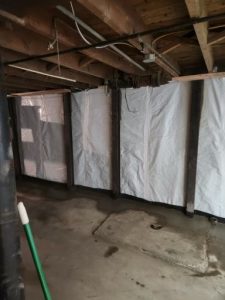 A house is a massive, heavy object designed to distribute its weight evenly across a concrete footer. When that weight distribution is disrupted, the house begins to move. In our specific Tri-State region, this is rarely due to poor construction and almost always due to the soil.
Differential Settlement vs. Uniform Settlement
Every house “settles” slightly after it is built. If a house settles uniformly (the whole structure sinks an inch evenly), you likely won’t notice anything more than a sticky door. However, differential settlement occurs when one corner or one specific wall sinks or moves while the rest of the house stays put. This creates immense shearing force. Because the wood framing of your house is bolted to the foundation, but the foundation is stuck in shifting soil, the materials eventually reach their breaking point and begin to separate.
The Role of Expanding Clay Soils in the Tri-State Area
The geography of the Pittsburgh-Buffalo-Youngstown corridor is dominated by “expansive” clay soils. Clay acts like a sponge. During the wet spring months typical of the Great Lakes region, the clay absorbs water and expands, pushing inward against your walls (hydrostatic pressure). During dry summer spells, the clay shrinks and pulls away, leaving a void. This constant “push-pull” cycle eventually weakens the connection between the wall and the footer, leading to the physical separation of the two components.
Top 3 Visual Red Flags of Wall Separation
You don’t need to be a structural engineer to spot the early warning signs of a house splitting from its footer. If you notice any of the following, the time for “watching and waiting” has passed.
1. The Horizontal “Separation Crack”
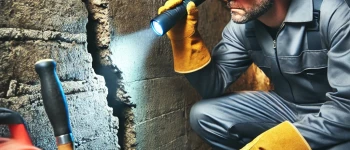
Look at the very bottom of your basement wall, where the block or poured concrete meets the floor. If you see a horizontal crack that appears to be widening, or if the wall seems to be “sliding” inward while the floor stays still, this is a clear sign of shearing. This often happens because the footer is held in place by deeper soil while the wall is being pushed by the upper layers of saturated clay.
2. Chimney or Porch Separation
Because chimneys are often the heaviest concentrated point of masonry on a home, they are the “canary in the coal mine” for foundation movement. If you step outside and see a gap between your chimney stack and the siding of your house—large enough to see daylight through—your foundation is tilting. The same applies to front porches that seem to be “leaning” away from the main entrance.
3. Stair-Step Cracking in Exterior Brick
In homes with brick or stone veneers, wall separation often manifests as diagonal cracks that follow the mortar lines in a “stair-step” pattern. If these cracks are wider at the top than at the bottom, it indicates that one side of the foundation is dropping or pulling outward, literally tearing the masonry apart.
Why “Patching” a Gap is a Dangerous Temporary Fix
It is tempting for a homeowner to see a gap and think, “I’ll just fill that with some hydraulic cement or caulk.” While this might stop a draft or a small leak temporarily, it is the equivalent of putting a Band-Aid on a broken leg.
Wall separation is a mechanical failure, not a cosmetic one. When a wall separates, the structural load of the house is no longer being transferred correctly to the earth. Filling the gap with mortar does nothing to stop the underlying soil movement. In fact, “plugging” a moving crack can actually cause more damage; as the house continues to shift, the rigid patch can create new pressure points, leading to explosive cracking in other areas of the basement.
Engineering Solutions: Helical Piers and Underpinning
At Highlander, we believe in “Science-Backed Methods.” To fix a house that is splitting from its footer, we must bypass the unstable soil and find a permanent anchor. We do this through a process called Underpinning.
- Helical Piers: These are large steel shafts with screw-like plates that are “driven” deep into the earth until they hit load-bearing strata or bedrock. We then attach heavy-duty steel brackets to your home’s footer and use hydraulic jacks to transfer the weight of the house onto the piers.
- The Lift: Once the piers are in place, we can often “lift” the separating section of the house back toward its original position, closing the gaps that have formed over years of settlement.
- Wall Stabilization: If the separation is caused by the wall bowing inward, we utilize carbon fiber reinforcement or steel I-beams to lock the wall to the floor joists, ensuring it can never move again.
Frequently Asked Questions
Q: Can a house be saved if the foundation is separating?
A: Absolutely. While it looks devastating, modern structural engineering allows us to stabilize and even lift houses that have significant separation. The key is catching it before the wood framing of the home undergoes permanent warping.
Q: How much does it cost to fix a separating wall?
A: Because every home sits on different soil and has different weight requirements, costs vary. The price is determined by how many piers are required to reach stable soil. A professional inspection from Highlander provides a fixed quote so there are no surprises.
Q: Is wall separation covered by homeowners insurance?
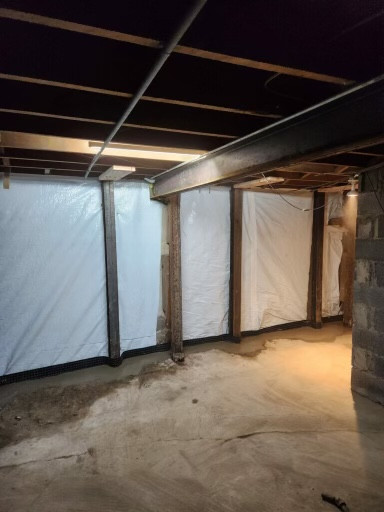
A: Standard policies typically exclude “earth movement” or settlement. However, addressing the issue now prevents a total collapse, which would be an even greater financial catastrophe. Highlander offers flexible financing to help homeowners protect their equity without delay.
Foundation wall separation is a clear signal from your home that it can no longer support its own weight against the shifting soils of the Northeast. Whether you are in Pittsburgh, Buffalo, or anywhere in between, the “freeze-thaw” cycles and clay-heavy terrain make our foundations particularly vulnerable to this type of structural splitting. Ignoring a gap between your wall and your footer won’t make it go away—it will only make the eventual repair more complex and costly.
By identifying the red flags—horizontal shearing, leaning chimneys, and stair-step masonry cracks—you can take action while the home is still easily restorable. At Highlander Waterproofing & Foundation Repair, we don’t just patch cracks; we provide engineered, permanent solutions backed by a lifetime transferable warranty. We protect your home, your family, and your investment by ensuring your foundation stays exactly where it belongs: firmly on its footer.
Ready to Secure Your Home?
Don’t let a “split” become a “collapse.” Contact the experts at Highlander today for a comprehensive structural integrity inspection. Our BBB Torch Award-winning team is ready to provide the science-backed solution your home deserves.
Call us today or visit our contact page to schedule your free evaluation!

Contact Information:
Highlander Waterproofing & Foundation Repair
1504 Scottsville Road #210
Rochester, NY 14623
United States
Giulio Bevilacqua
(877) 415-0564
https://highlanderwaterproofing.com/