Adults Aged 25-34 and 65 and Older Made Up the Largest Percentage of Users of the FAIR Health Consumer Website in 2025
PR Newswire
NEW YORK, March 3, 2026
Hundreds of Thousands of Users Visited the Free, Award-Winning Site
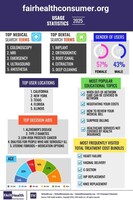
NEW YORK, March 3, 2026 /PRNewswire/ –In 2025, adults aged 25-34 made up the largest percentage of users of FAIR Health Consumer, while adults 65 and older (the largest user group in 2024) remained a high proportion of users. FAIR Health Consumer (fairhealthconsumer.org) is FAIR Health’s free, award-winning consumer website. Hundreds of thousands of users across all age groups visited the site last year. Other insights into search habits and user demographics in 2025 can be found in FAIR Health’s annual infographic on consumer website analytics.
For the 14th consecutive year, FAIR Health and its consumer website won multiple eHealthcare Leadership Awards for being reliable sources of healthcare information. In 2025, these awards included a silver award for Best Population Health, Prevention or Chronic Disease Management for fairhealtholderadults.org, the Older Adults section of FAIR Health Consumer. Funded by The John A. Hartford Foundation, FAIR Health for Older Adults offers shared decision-making tools, total treatment cost tools and educational resources to help older adults and family caregivers navigate the healthcare system and choose the best care for themselves.
Age
In 2025, adults 25-34 made up the largest share (22 percent) of website users, with adults 65 and older constituting the second largest share (19 percent). In 2024, adults 65 and older made up the largest share (22 percent) of website users. The website has largely maintained the high proportion of older adults beyond the 2024 national dissemination campaign, Healthy Decisions for Healthy Aging, which was funded by The John A. Hartford Foundation and drew attention to the FAIR Health for Older Adults section of the consumer website. This shows the continued value of this section for this age group. The age distribution of FAIR Health Consumer users in 2025 was:
- 65+: 19 percent;
- 55-64: 17 percent;
- 45-54: 16 percent;
- 35-44: 11 percent;
- 25-34: 22 percent; and
- 18-24: 10 percent.
Gender
In 2025, 57 percent of FAIR Health Consumer users were female, 43 percent male. The percentages of female and male users held approximately steady since 2024, when 58 percent of users were female and 42 percent were male.
Top Medical and Dental Search Terms
FAIR Health Consumer’s cost lookup tools allow users to estimate costs for medical and dental care by procedure and geographic location. In 2025, the top five medical terms searched with the medical cost lookup tool were:
- Colonoscopy;
- MRI;
- Emergency;
- Ultrasound; and
- Anesthesia.
From 2024 to 2025, “colonoscopy” (which was not in the top five in 2024) displaced “MRI” in the first position, moving it to second position. “Emergency” fell from second position to third position, where it displaced “CT scan,” which fell out of the rankings. The remainder of the top five medical terms were the same in both years.
In 2025, the top five dental terms searched with the dental cost lookup tool were:
- Implant;
- Orthodontic;
- Root canal;
- Extraction; and
- Deep cleaning.
The terms were the same as in 2024 except that “extraction” replaced “crown” in fourth position.
Top User Locations
The top five states from which visits to FAIR Health Consumer originated in 2025 were the same as in 2024:
- California;
- New York;
- Texas;
- Florida; and
- Illinois.
Top Decision Aids
Decision aids, which present treatment options for specific clinical conditions or scenarios, facilitate shared decision making—the discussion among patients, their caregivers and clinicians to decide on treatment based on clinical options and patient preferences and values. The groundbreaking decision aids on FAIR Health Consumer integrate cost estimates with clinical information. In 2025, the top decision aids on FAIR Health Consumer were:
- Alzheimer’s disease;
- Type 2 diabetes;
- Low-risk prostate cancer;
- Dialysis for people who are seriously ill; and
- Uterine fibroids—medication options.
The Alzheimer’s disease decision aid, which was newly introduced in 2025 with funding from The John A. Hartford Foundation, displaced early-stage breast cancer in first position. In second position, type 2 diabetes displaced nutrition options for people who are seriously ill. Low-risk (or slow-growing) prostate cancer remained in third position. In fourth position, dialysis for people who are seriously ill displaced ventilator options for people who are seriously ill. Uterine fibroids—medication options remained in fifth position.
The decision aids on FAIR Health Consumer were developed in connection with three separate grant projects: (1) an initiative to advance shared decision making for scenarios related to palliative care, funded by The New York Community Trust; (2) an initiative to advance shared decision making for conditions pertinent to patients of color, funded by the New York Health Foundation; and (3) an initiative to advance shared decision making for conditions particularly relevant to older adults, funded by The John A. Hartford Foundation.
Most Popular Educational Topics
FAIR Health Consumer features a rich array of FH® Insurance Basics, which are original articles that explain complex healthcare topics in easy-to-understand language. The most popular topics from this library in 2025 were:
- When Out-of-Network Care Can Be Covered in Network;
- Negotiating Your Costs;
- How to Review Your Medical Bill;
- Surprise Billing; and
- Healthcare Services Not Covered by Health Insurance.
From 2024 to 2025, the topics in the first, third and fifth positions remained the same. In second position, “Negotiating Your Costs” supplanted “Having More Than One Health Plan”; in fourth position, “Surprise Billing” displaced “Out-of-Network Doctors in In-Network Facilities.”
Most Frequently Visited Total Treatment Cost Bundles
FAIR Health Consumer’s medical cost lookup tool provides access to FH® Total Treatment Cost bundles. With these, users can view the typical costs for all components of care for certain chronic and acute conditions and event-based procedures. The most frequently visited bundles in 2025 were the same as in 2024:
- Heart failure;
- Vaginal delivery;
- C-section;
- Hip replacement; and
- Knee replacement.
For the infographic, click here.
Follow us on X @FAIRHealth
About FAIR Health
FAIR Health’s mission is to supply objective, unbiased information for all stakeholders to improve healthcare quality, access and affordability. It holds the nation’s largest collection of commercial healthcare claims data, which is growing at a rate of about four billion claim records a year. A national Qualified Entity certified by CMS, FAIR Health also receives all claims for individuals enrolled in traditional Medicare Parts A, B and D. As a testament to its reliability and objectivity, FAIR Health’s data products—including pricing benchmarks and custom analytics—are widely used by commercial insurers and self-insurers, providers, hospitals and healthcare systems, government, researchers and more. FAIR Health has been designated an official data source for state health programs, including workers’ compensation and personal injury protection (PIP) programs, and surprise billing laws that protect consumers. FAIR Health’s free consumer website and mobile app, available in English and Spanish, enable consumers to estimate and plan for their healthcare expenses and offer a rich educational platform on health insurance. The website has been honored by the White House Summit on Smart Disclosure, the Agency for Healthcare Research and Quality (AHRQ), URAC, the eHealthcare Leadership Awards, appPicker, Employee Benefit News and Kiplinger’s Personal Finance. FAIR Health is a national, 501(c)(3) nonprofit organization. For more information on FAIR Health, visit fairhealth.org.
Contact:
Rachel Kent
Executive Director of Communications and Marketing
FAIR Health
646-396-0795
rkent@fairhealth.org
 View original content to download multimedia:https://www.prnewswire.com/news-releases/adults-aged-25-34-and-65-and-older-made-up-the-largest-percentage-of-users-of-the-fair-health-consumer-website-in-2025-302702164.html
SOURCE FAIR Health