The Business Research Company’s Hydrogen Combustion Engine Global Market Report 2026 – Market Size, Trends, And Forecast 2026-2035
LONDON, GREATER LONDON, UNITED KINGDOM, October 27, 2026 /EINPresswire.com/ — The hydrogen combustion engine market is gaining significant traction as industries and governments focus on cleaner transportation solutions. With innovations in engine design and supportive policies, this sector is poised for rapid growth, especially in regions like North America where investment and infrastructure developments are accelerating. Let’s explore the current market size, key drivers, competitive landscape, and emerging opportunities shaping this evolving market.
North America Leads the Hydrogen Combustion Engine Market Growth
By 2030, North America is predicted to dominate the hydrogen combustion engine market, reaching a valuation of $30 billion, up from $17 billion in 2025. This represents an 11% compound annual growth rate (CAGR). The market is highly competitive, with global engine manufacturers and specialized hydrogen propulsion developers focusing on advancements such as high-pressure fuel injection, efficient combustion processes, and low-emission engine designs. Central to their strategies are regulatory compliance, optimizing engine performance, and integrating hydrogen as a fuel source.
Request A Free Sample Of The Hydrogen Combustion Engine Market Report
https://thebusinessresearchcompany.com/sample_request?id=75444682&type=smp&name=Hydrogen%20Combustion%20Engine%20Market%20Report%202026&utm_source=EINPresswire&utm_medium=Paid&utm_campaign=Oct_PR
Hydrogen-Specific Turbochargers Boost Engine Efficiency
A new wave of hydrogen-specific variable geometry turbochargers is revolutionizing this market by enhancing engine efficiency, improving combustion control, and enabling lower emissions in heavy-duty transport applications. For instance, in April 2025, Cummins Inc. unveiled the industry’s first hydrogen internal combustion engine turbocharger featuring variable geometry for European heavy-duty highway vehicles. Its custom aerodynamics, advanced diagnostic capabilities, and compliance with Euro VII emission standards contribute to better engine performance, increased reliability, and support the wider adoption of hydrogen-powered commercial vehicles.
Government Policies and Heavy-Duty Fleets Propel Market Expansion
Several factors are expected to drive the hydrogen combustion engine market’s swift expansion through 2030. One significant force is government initiatives aimed at decarbonizing transportation and industry. By offering incentives, tax breaks, research funding, and implementing stricter emission standards, governments are encouraging manufacturers and investors to develop hydrogen engines that leverage existing engine technology expertise. This push is anticipated to add approximately 2.1% annual growth to the market.
Access The Detailed Hydrogen Combustion Engine Market Report Here
https://thebusinessresearchcompany.com/report/hydrogen-combustion-engine-global-market-report?utm_source=EINPresswire&utm_medium=Paid&utm_campaign=Oct_PR
The role of commercial transportation and heavy-duty logistics is another critical growth driver. Vehicles like trucks, buses, and construction equipment demand long-range capabilities and quick refueling—needs that hydrogen combustion engines fulfill while producing far lower carbon emissions than diesel alternatives. Moreover, these engines fit well within existing vehicle platforms and supply chains, aiding fleet operators in meeting regulatory requirements amid rising freight activities. This factor is projected to contribute around 1.7% annual growth.
Hydrogen’s high auto-ignition temperature offers engineering advantages that further encourage market growth. Since hydrogen requires higher temperatures to ignite, engineers gain greater control over combustion, reducing the chance of unintended ignition during fuel handling and improving safety. This characteristic enhances efficiency, reliability, and safety in commercial and industrial environments and is expected to add about 1.3% annual growth.
Market Valuation Set To Surpass $81 Billion by 2030
The hydrogen combustion engine market is forecasted to exceed $81 billion by 2030. Within the broader Commercial Internal Combustion Engines sector, which is expected to reach roughly $321 billion by then, hydrogen combustion engines will represent about a quarter of the total market. In the context of the entire Machinery industry, anticipated to be worth $5,280 billion by 2030, this segment will account for close to 2% of overall value. The market is set to grow at an impressive CAGR of 12% leading up to 2030.
North America’s Rapid Growth in Hydrogen Combustion Engines
North America’s hydrogen combustion engine market is projected to expand from $17 billion in 2025 to $30 billion in 2030, reflecting an 11% CAGR. This growth is driven by supportive policies promoting clean hydrogen, tax incentives, and the rollout of new hydrogen fueling stations along key heavy-duty transport corridors. Investments in decarbonizing sectors such as aviation, maritime, and industrial power, along with active hydrogen engine programs by automotive and engine manufacturers, further stimulate market growth. Additionally, government-backed demonstrations of low-emission combustion technologies across the United States and Canada play a significant role.
The United States will be the leading country in this market by 2030, reaching $26 billion, up from $15 billion in 2025, with an 11% CAGR. This growth stems from accelerated investment in hydrogen mobility pilot programs targeting freight and logistics fleets, expanded use of hydrogen combustion systems for industrial backup and distributed power, partnerships between engine OEMs and energy companies focusing on fuel compatibility, increased federal and state funding for alternative fuel research, and new hydrogen-ready manufacturing and testing facilities concentrated in automotive and industrial hubs.
Proton Membrane Exchange Dominates Technology Segment
Among technological segments, proton membrane exchange (PEM) is expected to lead the hydrogen combustion engine market in 2030, commanding 68% of the market share, or approximately $55 billion. This dominance will be supported by advancements in membrane materials that enhance hydrogen ion conductivity, more systems enabling low-temperature startups suitable for mobility, compact fuel cell stacks used in hybrid propulsion, a focus on durability under variable transport and industrial loads, and ongoing catalyst improvements that reduce degradation and extend service life.
Additional Market Segmentation
The hydrogen combustion engine market is further categorized by installation type into OEM (original equipment manufacturer) and retrofit. Applications span passenger vehicles, commercial vehicles, ships, and other specialized uses.
Cummins Inc. Holds Top Position in the Market
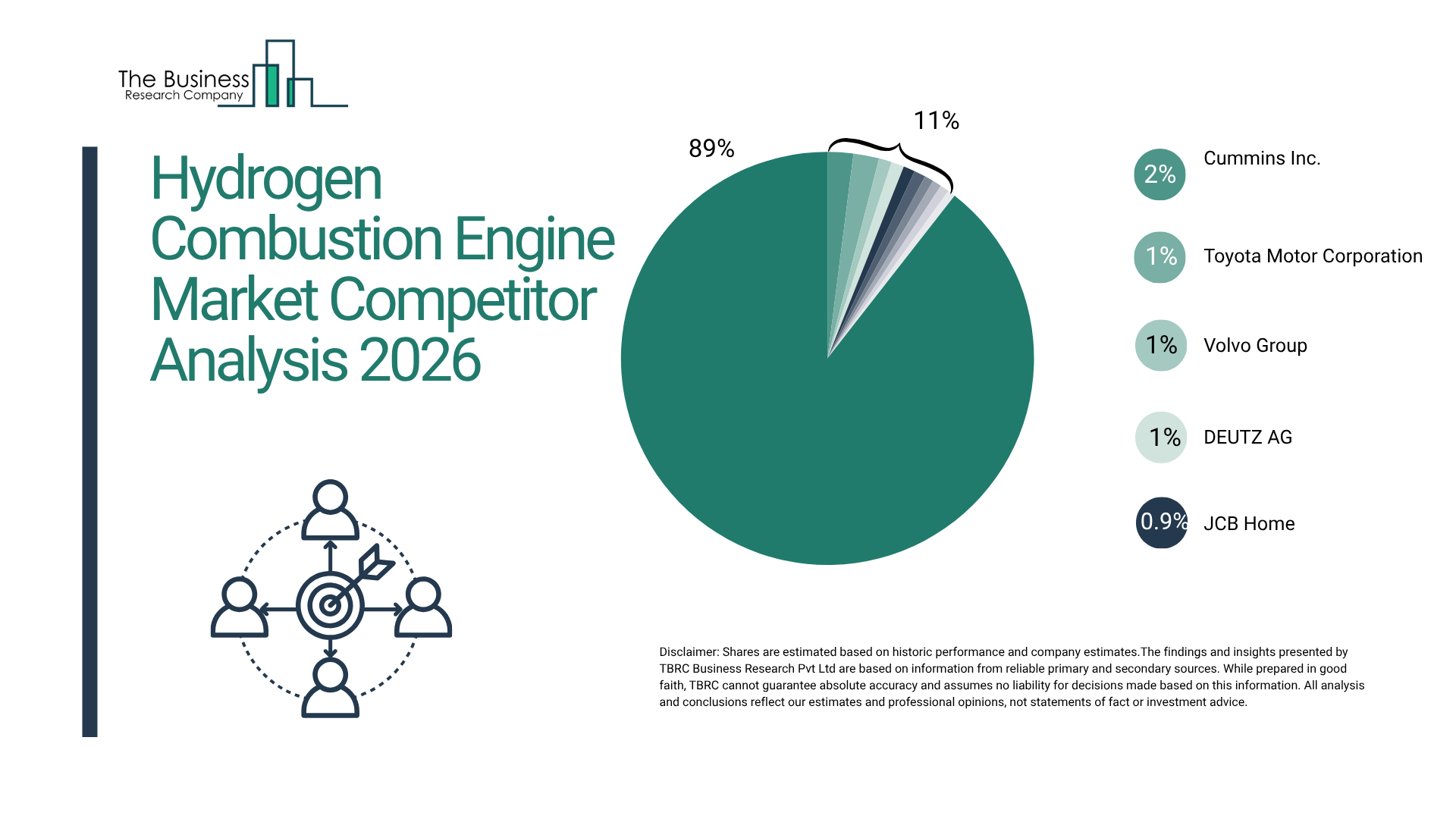
Cummins Inc. ranked first globally in hydrogen combustion engine sales in 2025, capturing a 2% market share. Its engine division, directly involved in the hydrogen combustion sector, provides hydrogen internal combustion engines, advanced powertrain technologies, fuel delivery systems, and engine solutions tailored for commercial vehicles, off-highway machinery, and industrial applications.
Key Players in the Hydrogen Combustion Engine Industry
The market features a diverse set of prominent companies including Cummins Inc., Toyota Motor Corporation, Volvo Group, DEUTZ AG, JCB Home, Weichai Power Co. Ltd., MAN Energy Solutions SE (Everllence), Caterpillar Inc., Mitsubishi Heavy Industries Ltd., Mazda Motor Corporation, Yamaha Motor Co. Ltd., Komatsu Ltd., Kubota Corporation, IVECO Group N.V., CNH Industrial, Bosch Mahle Turbo Systems GmbH & Co. KG, Perkins Engines, Hyundai Motor Company, Liebherr-International AG, Rolls-Royce Holdings plc, AVL List GmbH, HORSE Powertrain Solution SL, AGCO Corporation, and Origin Engines Inc.
Market Characterized by Fragmented Competition
The hydrogen combustion engine market remains fairly fragmented, with the top ten players accounting for only 11% of total revenue in 2025. Barriers to entry are moderate, influenced by stringent emission regulations, hydrogen safety standards, complex engine engineering requirements, and the necessity for dependable performance in commercial, industrial, and off-highway applications. Leading companies maintain their positions by offering diverse product portfolios, established manufacturing capacities, global distribution networks, and ongoing innovations in hydrogen engine and powertrain technologies. As demand for low-emission propulsion and hydrogen-powered commercial vehicles grows, partnerships, product innovations, and regional market expansions are expected to reinforce their market shares.
Market Shares Among Leading Companies in 2025
Cummins Inc. and Toyota Motor Corporation each held approximately 2% of the market share in 2025, followed by Volvo Group, DEUTZ AG, JCB Home, Weichai Power Co. Ltd., MAN Energy Solutions SE (Everllence), Caterpillar Inc., Mitsubishi Heavy Industries Ltd., and Mazda Motor Corporation each with about 1%.
Competitive Strategies Among Major Players
Top companies are advancing hydrogen combustion engine technologies to improve performance and fuel efficiency. They are also leveraging hydrogen infrastructure to accelerate commercial adoption and expanding hydrogen production and refueling networks to enhance clean mobility. Additionally, integrating sophisticated engine management systems helps boost efficiency and reliability across various applications.
Supply Chain Participants Like Linde plc, WESCO International Inc., and Toyota Motor Corporation
The hydrogen combustion engine market supply chain involves multiple players. Raw material suppliers include Linde plc, Air Liquide S.A., Air Products and Chemicals Inc., Messer SE & Co. KGaA, Taiyo Nippon Sanso Corporation, Iwatani Corporation, Hexagon Composites ASA, Worthington Enterprises Inc., Luxfer Holdings PLC, Parker Hannifin Corporation, Bosch Rexroth AG, Eaton Corporation plc, BorgWarner Inc., Garrett Motion Inc., Mahle GmbH, Rheinmetall AG, ElringKlinger AG, Forvia SE, Plastic Omnium SA, Ballard Power Systems Inc., Nel ASA, ITM Power PLC, Cummins Components and Software LLC, and Chart Industries Inc.
Wholesalers and distributors include WESCO International Inc., Fastenal Company, Motion Industries Inc., Applied Industrial Technologies Inc., Ferguson Enterprises Inc., Rexel S.A., Sonepar Group, Graybar Electric Company Inc., RS Group plc, Macnica Inc., Marubeni Corporation, Sumitomo Corporation, Mitsui & Co. Ltd., Sojitz Corporation, Toyota Tsusho Corporation, Hanwa Co. Ltd., Itochu Corporation, Mitsubishi Corporation, Brenntag SE, Univar Solutions Inc., Helm AG, Biesterfeld AG, DKSH Holding Ltd., BDI-BioEnergy International GmbH, and Nippon Steel Trading Corporation.
End users of hydrogen combustion engines feature major automotive and heavy machinery manufacturers such as Toyota Motor Corporation, Hyundai Motor Company, Honda Motor Co. Ltd., Nissan Motor Co. Ltd., Mazda Motor Corporation, Isuzu Motors Limited, Mitsubishi Fuso Truck and Bus Corporation, Hino Motors Ltd., Deutz AG, JCB Limited, AGCO Corporation, CNH Industrial N.V., IVECO Group N.V., Volvo Group, Daimler Truck Holding AG, MAN Truck & Bus SE, Komatsu Ltd., Kubota Corporation, Liebherr-International AG, Yanmar Holdings Co. Ltd., Weichai Power Co. Ltd., Rolls-Royce Holdings plc, Kawasaki Heavy Industries Ltd., Mitsubishi Heavy Industries Ltd., and Doosan Infracore Co. Ltd.
Future Growth Prospects in the Hydrogen Combustion Engine Market
Among technological segments, proton membrane exchange, phosphoric acid fuel cells, and other emerging technologies offer the most promising opportunities, collectively expected to add over $34 billion in value by 2030. Specifically, proton membrane exchange is projected to grow by $24 billion, phosphoric acid fuel cells by $7 billion, and other technologies by $3 billion between 2025 and 2030. This growth will be driven by increased use of hydrogen propulsion in heavy-duty rail and long-haul freight, hybrid hydrogen-electric drivetrains in commercial vehicles, investments in decentralized refueling and onsite hydrogen production, high-power-density engines for industrial and off-road machinery, and collaborative pilot programs involving energy utilities, transport operators, and propulsion developers. These initiatives reflect a transition toward hydrogen-fueled combustion engines and hybrid energy systems that enhance energy diversity, operational flexibility, and long-term decarbonization goals.
New strategic additions in our 2026 market reports include market attractiveness scoring and analysis, total addressable market (TAM) analysis, company scoring matrix graphics and tables, Excel-based forecasting dashboards, market hotspots infographics, key technologies and future trend analysis, along with updated graphics and tables.
Learn More About The Business Research Company
The Business Research Company (www.thebusinessresearchcompany.com) is a leading market intelligence firm renowned for its expertise in company, market, and consumer research. We have published over 30,000+ reports across 27 industries and 60+ geographies. Our research is powered by 1,500,000 datasets, extensive secondary research, and exclusive insights from interviews with industry leaders.
We provide continuous and custom research services, offering a range of specialized packages tailored to your needs, including Market Entry Research Package, Competitor Tracking Package, Supplier & Distributor Package and much more.
Disclaimer: Please note that the findings, conclusions and recommendations that TBRC Business Research Pvt Ltd delivers are based on information gathered in good faith from both primary and secondary sources, whose accuracy we are not always in a position to guarantee. As such TBRC Business Research Pvt Ltd can accept no liability whatever for actions taken based on any information that may subsequently prove to be incorrect. Analysis and findings included in TBRC reports and presentations are our estimates, opinions and are not intended as statements of fact or investment guidance.
Contact Us:
The Business Research Company
Americas +1 310-496-7795
Europe +44 7882 955267
Asia & Others +44 7882 955267 & +91 8897263534
Email: marketing@tbrc.info
Follow Us On:
LinkedIn: https://in.linkedin.com/company/the-business-research-company“
Oliver Guirdham
The Business Research Company
+44 7882 955267
info@tbrc.info
Visit us on social media:
LinkedIn
Facebook
X
Legal Disclaimer:
EIN Presswire provides this news content “as is” without warranty of any kind. We do not accept any responsibility or liability
for the accuracy, content, images, videos, licenses, completeness, legality, or reliability of the information contained in this
article. If you have any complaints or copyright issues related to this article, kindly contact the author above.

Media gallery