Discovery could explain cosmic phenomena without requiring the mysterious dark matter and dark energy that dominate current physics models.
TORONTO, ON, CANADA, April 20, 2026 /EINPresswire.com/ — A research program completed earlier this year at the Institute of Integrative and Interdisciplinary Research (IIIR) predicted that the early universe should have produced a specific background of gravitational radiation at the moment when matter first formed. A new analysis suggests that this radiation may have already been detected by the NANOGrav collaboration.
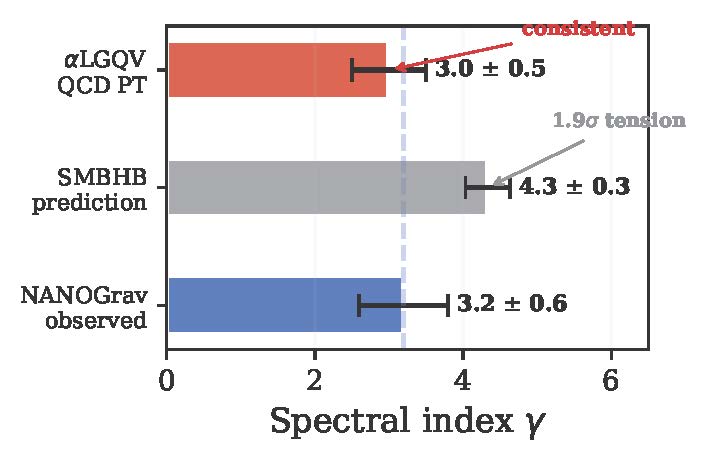
NANOGrav collaboration reported that the universe appears to be filled with a faint, constant hum of gravitational waves. The origin of this hum has not been established. The most discussed explanation — distant pairs of massive black holes — does not fully match the observed pattern.
The Local Gravity of Quantum Vacuum (αLGQV) framework, published by IIIR as a comprehensive monograph, proposes that the quantum vacuum gravitates locally — not as a uniform cosmological constant, but in proportion to the matter present. One implication is that the vacuum itself underwent a transition in the very early universe — when quarks became permanently bound inside protons and neutrons. The framework predicts that this transition should have produced gravitational radiation with specific, calculable properties.
This discovery may represent a gravitational analog to the cosmic microwave background (CMB) — the faint electromagnetic afterglow that astronomers detect over 50 years ago.
“This gravitational background would tell us about the universe when matter itself first formed.” said Boris Kriger, Lead Investigator, “We would be detecting the trace of quarks becoming confined — the moment when the fundamental building blocks of all matter settled into their permanent arrangement.”
A new analysis finds that the predicted properties — the strength, the frequency range, and the spectral shape of the radiation — are consistent with what NANOGrav has observed. The predicted strength falls within the uncertainty range of the independently fitted NANOGrav value. The predicted spectral shape matches the observation more closely than the black hole explanation does.
The analysis does not prove that the NANOGrav signal is this relic radiation. The signal may come from multiple sources, and the calculation uses an approximate model. However, the properties of the predicted radiation were fixed before the comparison was made. Nothing was adjusted to improve the match.
If validated, this detection would represent a breakthrough in what could be called “gravitational archaeology” — using gravitational waves to probe epochs of the universe far beyond the reach of electromagnetic observations. It would provide the first direct evidence of the QCD confinement transition, one of the most important events in cosmic history, and would validate a unified framework that explains dark energy, dark matter, and primordial gravitational waves through a single mechanism rooted in known nuclear physics.
“As with everything in this program, there is nothing adjustable or questionable here,” said Kriger. “The formulas are from established literature. The nuclear data has been in textbooks for decades. The NANOGrav data is public. Any physicist can reproduce the entire calculation in half an hour. We are simply connecting results that already exist in different fields.”
Kriger expressed particular gratitude to Professor Stanley J. Brodsky of SLAC/Stanford University for his serious and sustained support of the program, for his foundational 2011 paper on the cosmological constant and light-front holography, and for the engagement of his collaborators who provided detailed scientific correspondence throughout the development of the framework, although stressed that none of them have expressed support or endorsement for the entire framework.
The paper has been submitted to Nature Astronomy (manuscript number NATASTRON-26040617) and is undergoing editorial review. All analysis code and data are publicly available. The prediction is explicitly falsifiable: the paper states specific observational outcomes that would rule it out.
The paper is available at https://doi.org/10.13140/RG.2.2.25379.82721
The full materials are accessible at:
https://interdisciplinary-research.institute/cosmology-and-theoretical-physics/
Scientific Community Reception
https://interdisciplinary-research.institute/reception/
Explanatory podcast for public:
https://youtu.be/V7NrRpv2_xs
Boris Kriger | Research Fellow ORCID: orcid.org/0009-0001-0034-2903 https://www.researchgate.net/profile/Boris-Kriger
Institute of Integrative and Interdisciplinary Research +1 437-552-8807 interdisciplinary-institute.org boriskriger@interdisciplinary-institute.org
About the Institute The Institute of Integrative and Interdisciplinary Research (IIIR) is a Toronto-based organization dedicated to solving complex problems through formal precision and cross-domain synthesis. Treating interdisciplinarity as a methodological necessity, the Institute bridges the gap between specialized fields to develop coherent theoretical architectures.
Boris Kriger
Institute of Integrative and Interdisciplinary Research
+1 437-552-8807
email us here
Visit us on social media:
YouTube
A gravitational analog to the cosmic microwave background radiation?
Legal Disclaimer:
EIN Presswire provides this news content “as is” without warranty of any kind. We do not accept any responsibility or liability
for the accuracy, content, images, videos, licenses, completeness, legality, or reliability of the information contained in this
article. If you have any complaints or copyright issues related to this article, kindly contact the author above.

Media gallery